

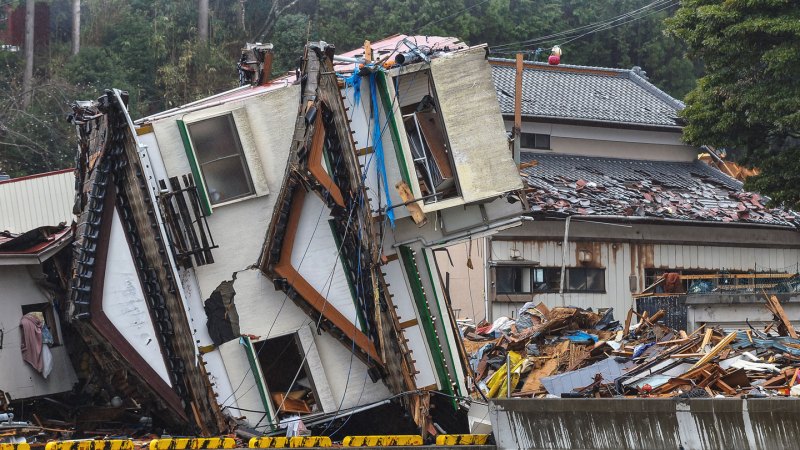
Not long after a powerful earthquake rocked Japan, the whole country moved a few millimeters east. The cause, researchers report June 18 in Science, was a seismic wave that plunged to Earth’s core and back, causing faults to slip — the first recorded case of a core-reflected wave setting a fault in motion.
Earthquakes routinely move landmasses. But they don’t usually shift entire countries, and seismic waves bouncing off the planet’s core haven’t been the culprit. Such core-reflected S waves, as they’re called, barrel down through all 2,900 kilometers of Earth’s rocky mantle to reach the core’s edge, then return.
Seismologist Sunyoung Park and her colleagues detected one such wave while mining archival seismic and GPS data from Japan’s March 11, 2011 Tohoku earthquake. That wave showed up roughly 15 minutes after the magnitude 9.0 mainshock and was accompanied by a coincident shifting of the ground, as recorded by hundreds of GPS sensors spread across Japan. “We see this permanent offset,” says Park, of the University of Chicago.
Such ground displacement means the wave did more than simply pass by, says Caltech seismologist Zachary Ross, who was not involved in the research. “That implies that there’s some amount of fault slip.”
And since the shift occurred across the entirety of Japan — from the island of Hokkaido in the north to the island of Kyushu in the south — a large swath of plate boundary must have proverbially unzipped, Park and her colleagues conclude. In fact, the team determined that two separate plate boundaries, totaling at least 3,000 kilometers in extent, probably let loose.
That makes sense, says Andrea Donnellan, a geophysicist at Purdue University in West Lafayette, Ind., who was not involved in the research. A seismic wave can trigger the release of tectonic stress that’s built up over decades, centuries or even millennia, she says. “I think it’s very plausible.”
This is the first time that a core-reflected S wave has been shown to trigger a fault to slip, Park says. “That’s a type of seismic hazard that we didn’t think about before.” Such a long rupture length is also unprecedented — it’s more than twice the rupture length of the massive 2004 Sumatra earthquake.
In the case of the Tohoku earthquake, the slippage caused by the core-reflected S wave probably wasn’t perceptible. That’s because its energy was distributed over such an enormous area and it occurred relatively slowly, over the course of about three minutes. But future events, the researchers say, might not be so benign.


