

In March 2025, Reps. Mike Kelly (R-PA) and Bill Foster (D-IL) reintroduced the MATCH IT Act (also known as the Patient Matching and Transparency in Certified Health IT Act), with backing from AHIMA, HIMSS, CHIME, AMIA, and the American College of Physicians.
The bill seeks to tackle the U.S. healthcare system’s prevalent patient matching error problem. According to Black Book Research, one in three healthcare claim denials stems from inaccurate patient matching, costing the average hospital $2.5 million annually and the industry an estimated $6.7 billion each year. And in the past, Pew Charitable Trusts reported that match rates between healthcare organizations have been measured as low as 50% in some interoperability scenarios.
But MATCH IT may not fix the root problem, and hybrid deterministic-probabilistic strategies present a better path forward.
Why the MATCH IT debate matters
Beyond the financial costs, patient matching errors can harm patients. They can result in delayed care, incorrectly prescribed medicine and treatments, privacy violations, duplicate medical records, denied claims, and other adverse consequences.
In the past, a study from RAND Corporation found that patient-to-record mismatches occurred about 8% of the time on average. Meanwhile, the Office of the National Coordinator for Health Information Technology has previously reported that exchanging records across health systems could yield error rates as high as 50%–60%.
Where MATCH IT falls short
The Act would do the following:
- Direct HHS to establish an industry-wide definition of “patient match rate”
- Require ONC to adopt a minimum demographic data set for certified health IT
- Create a voluntary Medicare bonus for providers who clear an accuracy threshold, once one exists
In simple terms, it standardizes how patient matching performance is measured. But critics argue it stops short of prescribing which matching methodology should be used, leaving the door open for errors to continue occurring.
Could hybrid deterministic-probabilistic strategies be a better solution?
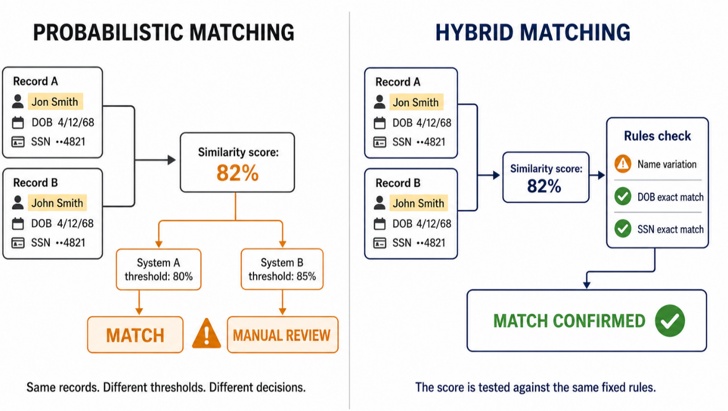
Currently, many patient matching systems used in EHRs run probabilistic scoring against demographic fields. According to a study from the Journal of the American Medical Informatics Association, these fields commonly include name, date of birth, sex, address, phone number, and sometimes Social Security number. Each health system then sets its own confidence threshold for what counts as a match. “Possible” matches are forwarded for manual review.
One concern with this approach is that because those thresholds can vary by organization, the same pair of records can be classified differently across health systems, even if they have identical demographic information.
Some MATCH IT critics argue that a strategy combining probabilistic scoring and deterministic rules would address this problem. In practice, this often means tracking a wider list of fields that includes legal name, date of death, Social Security number, place-of-death county code, gender, record ownership status, abandonment status, and upload status.
What can vital records systems teach health IT?
In 2025, the Social Security Administration (SSA) mistakenly declared two living men dead. Both had their benefits cut off over demographic mismatches that took months to resolve. This case showed that errors in EHR-based patient matching aren’t a new problem.
State vital records systems face a similar issue with far less room for error. These systems register roughly 2.8 million deaths a year, feeding identity data downstream to Social Security, Medicare, insurers, and pension boards. A false positive in the data could cut off a living person’s benefits, while a false negative could mean a fraudulent claim continues undetected.
Some states are managing these risks for electronic death registration systems by using a hybrid deterministic-probabilistic strategy, which is helping catch errors a narrower EHR-style match would miss.
For example, combining a deterministic match on SSN and date of death with a probabilistic check on name variants resolves cases that would otherwise be sent to manual review by a system that scores only name and birth date.
Nevertheless, while hybrid approaches can improve matching performance, they may not be without their trade-offs. The Office of the National Coordinator for Health IT (ONC) notes that they can require complex configuration, governance, and monitoring to implement. Critics also argue they’re not a silver bullet solution. For example, organizations could still implement different thresholds, so matching outcomes can still vary across systems — even if to a lesser degree compared to non-hybrid approaches.
The big picture
Despite its potential trade-offs, hybrid deterministic-probabilistic matching has been proven to work. It’s a strategy that’s trusted even in high-stakes settings, where the slightest error could mean cutting off a living person’s benefits.
On the flip side, MATCH IT has been introduced twice but has not passed. Even if it does pass, its provisions still wouldn’t address why patient matching errors occur. Meanwhile, the industry will continue incurring $6.7 billion in matching-related costs per year.
If you lead health IT at a hospital or health system, ask your vendor this week whether your patient-matching system runs deterministic rules alongside probabilistic scoring, or only probabilistic scoring. If it’s the latter, switching to a hybrid model could improve your outcomes quickly. No waiting for Congress required.
Photo: invincible_bulldog, Getty Images

Nidhi Singh is a senior data analyst who works in health data governance and identity-matching systems in state government.
This post appears through the MedCity Influencers program. Anyone can publish their perspective on business and innovation in healthcare on MedCity News through MedCity Influencers. Click here to find out how.


