

As a child growing up in small-town Nova Scotia, 25-year-old Avery Schrader craved adventure. After finishing high school, he moved to Germany. There, he worked in a kitchen cutting up vegetables and listening to podcasts. This inspired him to start his own. He moved to Estonia, the Silicon Valley of Europe, and began interviewing entrepreneurs and learning about startups from the best of the best. In 2020, he founded Modash, a platform that helps brands connect with content creators. Today Modash employs 30 people, has raised $2 million in funding, and is on track to have facilitated three million partnerships.
Schrader has the kind of easy charisma that makes for top-quality TikToker and Instagram content. He peppers his conversation with quirky details that linger in one’s memory—for example, Nova Scotia is “a place of rocks and trees.” Fast Company sat down to ask him about how he went from a small town Canada to aspiring tech mogul in Estonia.
Fast Company: How did you get started?
Avery Schrader: The really cool thing about Estonia is having a $100 video camera and a lapel mic is enough to get to interview some of the best entrepreneurs on Earth. I totally shouldn’t have because I grew up in middle of nowhere and had very little knowledge—I didn’t even know what a startup was when I moved to Estonia. I got to talk to Peter Vesterbacka, the guy who built Angry Birds, and Martin Villig, the CEO of Bolt [formerly Taxify], which is Uber’s main competitor now. One day I was doing a show with a founder named Kaarel Kotkas [CEO of the startup Veriff]. I had such a good time and learned so much that I had this feeling that everybody should be able to do what I’ve done now, which is come from the middle of nowhere, with no prerequisite knowledge, and turn an interest in telling stories into opportunity. We built Modash with the mission of helping every creator earn a living.
FC: How does Modash work?
AS: Most creators earn a living through brand sponsorships. But despite the fact that most creator income comes from brands, and brands are really excited about creators, the space is still really, really early. And brands don’t know how to partner with lots of these people. We wanted to make this easy and effective so influencer partnerships can compete with marketing on Google or Facebook. We built a search engine that lists every creator on Earth, which is to say we analyze publicly available data on the major social media platforms, and include anyone who has over 1,000 followers and doesn’t have private data—we have a couple hoops people have to jump through, and people can also opt out, but most don’t.
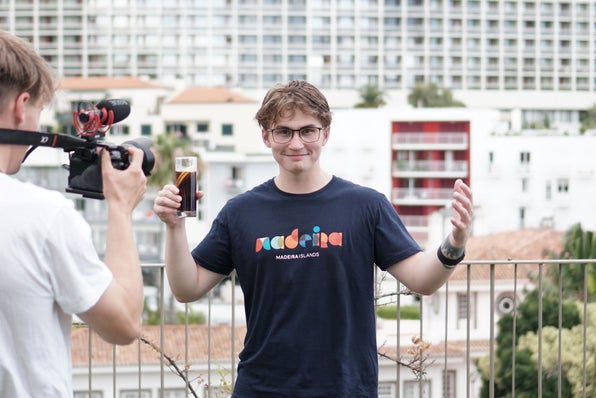
Modash creates this meritocracy, where every brand has a different little thing they’re looking for, and before they couldn’t find it, but now they can. And so that person who never would have been found because they’re too small or they’re too niche now has a fair shake at getting a deal.
FC: How do brands hear about you?
AS: One thing about being obsessed with creators my entire life was that I was pretty okay at making content that people want to consume. We wrote and built little mini tools and stuff that people can use for free. So for example, if you google “fake follower check,” Modash is almost always at the top. Any brands that have concerns about fake followers for creators will find us. Through that, we’ve gone viral on Tiktok. For example, one TikToker created a video using Modash to analyze how many fake followers Lionel Messi has versus Cristiano Ronaldo. That video exploded and I was so confused . . . I kept wondering, Where are these numbers coming from?
FC: What advice do you have for brands and creators for forming effective partnerships?
AS: From the brand side, it’s a lot about understanding that there is a real human being on the other end of the partnership. Oftentimes, as marketers, we’re so focused on figuring out how to get something to scale; how to reduce our cost per acquisition; basically, how do I structurally tweak every little thing I do, so that this channel becomes more efficient? The thing that’s different about creative partnerships is you have this person on the other end of [the] growth channel, whose life is about making beautiful things and telling stories. That’s what they want to spend their time on. And if you forget about that, and you forget to treat them as an individual—and treat them more like a billboard—the results aren’t great.
So some easy ways to solve for that are have long-term relationships with creators, rather than just a selfie and then never talking to them again. Also align incentives for both sides. When creators get paid to actually convert customers, it encourages the creators to produce more and think about what interesting stories they can tell. And it helps brands to actually support creators.
From the creator side—you can try to help the brand do that by investing a little bit more. What happened was, in the early days, the creative was really good. The creators were producing incredible things for brands. And then over time the brands came in, and they’re old and stuffy, and traditional. And so they said, follow the brand guidelines. And so creators were trained to say the words and do the thing. But everybody knows that those things underperform. The advice to creators, then, is push back a little bit if brands give you really stringent guidelines and help them understand why telling better stories will drive better results for both sides.
FC: And what are brands and creators getting wrong?
AS: A lot of brands will make assumptions that aren’t backed up by data. Say I want to sell fancy deodorant to Texans, then you pick a creator who makes Instagram photos in Texas but it doesn’t work . . . You need a more intentional approach. Brands need to pick creators who are actually reaching their target audience, and they need to define their target audience well. As a creator, you also want to think about the brands that will solve a problem for your audience and resonate with them—then you’ll perform better. Your brands will be happier. Your audience will trust you more because you’re talking to things that matter to them.
Another piece of advice I have is for brands to be aware of what is out there. When you’re a publicly traded company working with thousands of content creators, it’s easy to get hung up on metrics—does someone have a 5% engagement rate? But if you are trying to target Estonian men in their 20s and 30s, maybe there aren’t that many creators out there reaching that audience and 5% isn’t possible. Maybe 2% is more realistic. You need to think bigger picture.
FC: Any last thoughts for our readers?
AS: Today from the outside, it might look like our mission of helping creators get paid doesn’t align with our product. This is a very strategic decision. In a year or two, I think it will become very, very obvious why we did it this way. And maybe that’s the mystery that I leave you with.
FC: Oh c’mon, you can’t leave me with just that!
AS: The problems that creators have are basically the problems of the next generation of small business. We have the opportunity to help creators get paid a little faster, make handling their books easier, invoicing, etc. We are their income, which is brand partnerships, and we can help them manage that income. Modash will basically be the Intuit of the creator economy. No one is better positioned to do that than we are. We’ll be transferring, next year, hundreds of millions of dollars to creators, so it’s a pretty good distribution flywheel.


