

[ad_1]
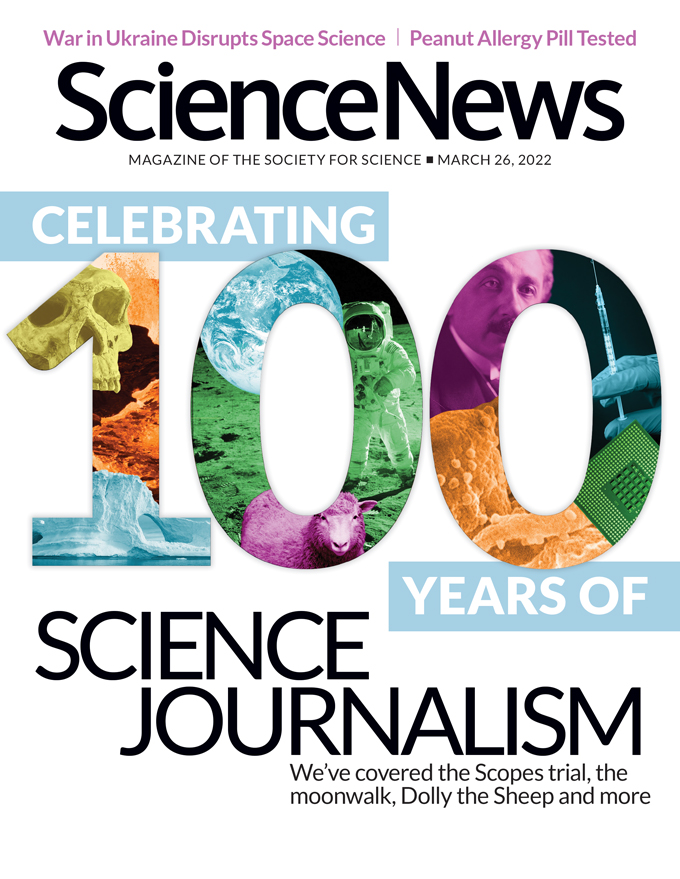
Reflecting on our past
During Science News’ early history, in the 1920s through ’60s, we shared and endorsed ideas that were unscientific, racist, sexist and morally wrong. In “The darkness in our past” (SN: 3/26/22, p. 26), the Science News reckoning team and senior staff apologized for these past prejudices and vowed to hold ourselves accountable moving forward.
Many readers commended Science News for doing this work. “I can’t thank you enough for [this] excellent and insightful article,” reader Kirsten Muir wrote. “It is sobering to read, but enormously appreciated in light of your different attitude today and ongoing scientific rigor. It is important for you to have been open and transparent about your past, and I greatly respect and admire you for it.”
The article made reader Roberta Riggs, who grew up in the 1950s and ’60s, reflect on the social and cultural transformations she has experienced during her lifetime. “I really appreciate the fact that you showed honest grief for stepping over the line,” Riggs wrote. “Change is a hard thing to do. But I have changed, hopefully for the better. I have changed my opinion on a great many things, and a lot of that, I believe, is because of the articles I have read in your magazine.… Since we cannot go backward, we must do what we can now, for today and every day that we have as we live out our lives.”
Crater questions
A space rock probably about 4 to 5.4 kilometers wide crashed into Earth about 280 million years ago, and material blasted from that impact may have created a bevy of secondary craters, Sid Perkins reported in “Impact caused a cascade of craters” (SN: 3/26/22, p. 12).
Reader Anne Wolfe wondered how the ancient space rock’s size compares with others in space, and whether it traveled alone.
Much bigger asteroids exist in the asteroid belt. But of the more than 28,000 known asteroids near Earth, only about 900 are at least 1 kilometer wide, says planetary scientist Thomas Kenkmann of the University of Freiburg in Germany. On average, a space rock several kilometers in diameter hits Earth about once every several million years, making it a rare event, he says. Although some asteroids have satellites or companions, it’s unclear whether the rock that struck Earth about 280 million years ago was traveling solo.
Wolfe also wondered in what other ways the primary impact affected the environment.
The blast wave generated by the impact would have devastated areas within a few hundred kilometers of the crash, Kenkmann says. In addition, heat from the impact most likely burned everything within that same radius.
Parched plants
South Africa’s fynbos plants use their long, thin roots to commandeer soil nutrients and keep adjacent forest from encroaching on fynbos territory, Jake Buehler reported in “African shrubs weaponize skinny roots” (SN: 3/26/22, p. 10).
Reader Wendy asked whether fynbos roots also take up water from soil faster than the nearby forest plants.
Thin roots are generally more efficient than thicker roots, such as those of forest trees, at absorbing water from soil within a small window of time, says ecologist Mingzhen Lu of the Santa Fe Institute in New Mexico. But thick roots live longer. In forests’ more stable soil environment, where moisture fluctuates less dramatically compared with fynbos soils, thick roots would be able to provide forest species a steady flow of water, he says.
[ad_2]
Original Source Link


