

Strong solar activity can nudge space debris orbiting Earth out of the sky.
As solar cycles reach their peak — signaled by numbers of sunspots appearing on the sun’s surface — satellites and other objects in low Earth orbit lose altitude more quickly, researchers report May 6 in Frontiers in Astronomy and Space Sciences. Understanding the sun’s role in orbital decay could be a boon to space operations planning, the team says. That’s especially timely as the proliferation of human-made space debris presents a growing threat of collisions with operational satellites and spacecraft.
By tracking the positions of 17 pieces of space debris in low Earth orbit for more than three decades, astrophysicist Ayisha Ashruf and colleagues at the Vikram Sarabhai Space Centre in Thiruvananthapuram, India, identified a clear threshold beyond which increases in solar activity impacted the objects: When sunspot numbers reached about 70 percent of their peak numbers, orbital decay rates rose sharply.
The study is the first to demonstrate this long-suspected link between solar activity and the fate of space junk.
Falling debris
The altitude of a piece of space junk, originally from a Delta 1 rocket (black line), shows a stepwise decrease through three solar cycles (shaded blue, green and red) from 1986 to 2024. Peak solar activity in each cycle (dashed red lines) corresponds to a sharp decline in the object’s altitude, after which the orbit levels out until the next peak.
Altitude of one piece of debris, 1986–2024
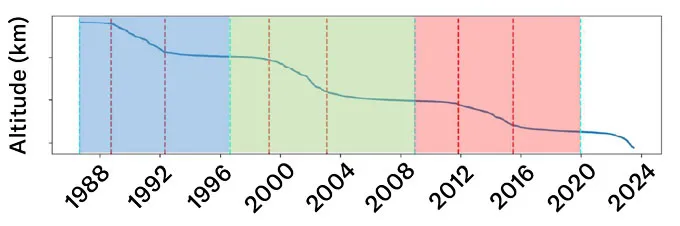
The sun’s radiation emission intensity waxes and wanes over a roughly 11-year cycle. At the peak of each cycle, a surfeit of sunspots blooms on the sun’s surface. More intense radiation also streams toward Earth, heating up and expanding an outer layer of atmosphere known as the thermosphere. Objects in low Earth orbit — a zone about 160 to 2,000 kilometers from Earth’s surface — can find themselves wading through denser atmosphere, adding friction and slowing them down. And slowing down can mean they descend out of orbit sooner than they would have otherwise.
That’s what happened to the 17 objects that Ashruf and her colleagues studied as each of three consecutive solar cycles from 1986 to 2024 rose to peak activity. These objects circle Earth every 90 to 120 minutes, at altitudes between 600 and 800 kilometers. Each time the cycle passed the sunspot threshold, the space junk gradually dropped a few kilometers in altitude, the researchers found. That threshold pattern held true from cycle to cycle, though where exactly the sunspot threshold occurred, and how much the objects’ altitude decreased, also depended on the overall intensity of the solar cycle.
Identifying this pattern could be particularly helpful as missions identify the best launch windows to avoid any collisions with debris, the team says — a need that will become even more acute as space junk accumulates.
Original Source Link


