

Plantlike designs on pottery made almost 8,000 years ago may be the earliest evidence yet of mathematical thinking.
Many of the flower decorations painted on pottery by an ancient culture in northern Mesopotamia exhibit regular numbers of petals determined by a mathematical progression, a pair of archaeologists from the Hebrew University of Jerusalem report in a recent study. This finding, the scientists say, suggests that these people used a similar understanding for the division of land and agricultural produce.
While plants are lacking among the many ancient cave drawings made by Homo sapiens up to 46,000 years ago, plant motifs — including trees, branches, shrubs and flowers — are common in the pottery decorations of Mesopotamia’s Late Neolithic Halafian people, who lived between 6200 and 5500 B.C.
The new study, published December 5 in the Journal of World Prehistory, catalogs all the plant motifs on Halafian pottery fragments. But it’s the flowers, Yosef Garfinkel says, that “give us an indication of mathematical knowledge.”
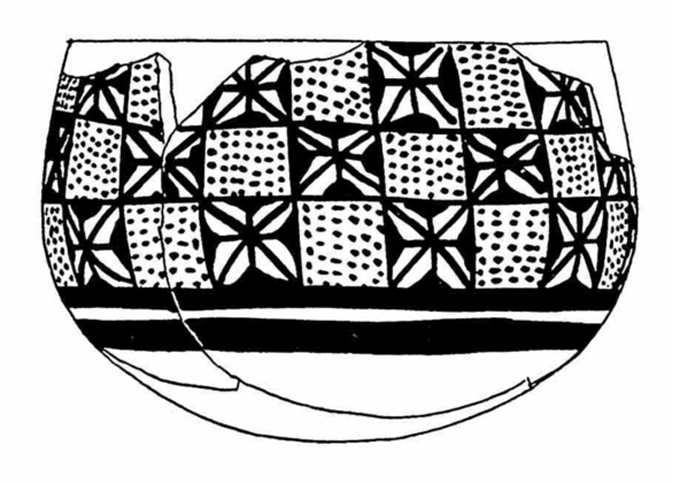
Garfinkel and Sarah Krulwich examined thousands of Halafian pottery fragments unearthed at archaeological sites since the 1930s and identified 375 with designs depicting flowers. In nearly every case, the flowers were illustrated with four, eight, 16, 32 or 64 petals — a “geometric” progression that implies the designs were inspired by powers of two, Garfinkel says.
The large patterns on some of the fragments also suggest mathematical knowledge. Many are from ornately-painted bowls, including some painted with stylized flowers inside checkerboard patterns.
The authors argue that these numbers are not accidental but indicate that the Halafians possessed advanced knowledge of this type of mathematics. This understanding — based on the progressive doubling of numbers — may have been developed by the Halafians for dividing land or crops into equal shares. “This is evidence of mathematical knowledge that we are not aware of from any other source,” Garfinkel says.
Halafian mathematics differ significantly from the base-60, or sexagesimal, mathematics pioneered by the Sumerians in roughly the same region more than 1,500 years later. While base-60 has largely been supplanted by base-10 mathematics, it is still used in timekeeping, astronomy and geometry. “What we have here,” Garfinkel says, “is an earlier mathematical system, before sexagesimal.”
Original Source Link


