

ScienceThis microbe turns into a cannibalistic ‘Hulk’

This microbe turns into a cannibalistic ‘Hulk’


A newly discovered microbe is like a mini version of the Hulk.

Euplotes gigatrox is a single-celled protist that resembles an insect. It grazes on bacteria and other tiny microbes. Sometimes a small number of the protists balloon into “supergiants” more than twice their regular size. The huge cells cannibalize their smaller, genetically identical brethren. The triggers for the change aren’t entirely clear, but it tends to happen when there is plenty of food, researchers reported May 14 in the Proceedings of the National Academy of Sciences.

The transformation happens in stages, says Ben Larson, a cell biologist at Rensselaer Polytechnic Institute in Troy, N.Y., who discovered the microbes in gunk scraped from an aquarium filter in Curaçao.

First, “a cell gets a big mouth, and they start running around like crazy,” Larson says. At that stage they aren’t very good at cannibalism, but if a would-be Hulk manages to capture one of its siblings or cousins in its enlarged mouth, “the body plan of the cell rescales, and they grow up to be these just enormous cannibalistic supergiants.”
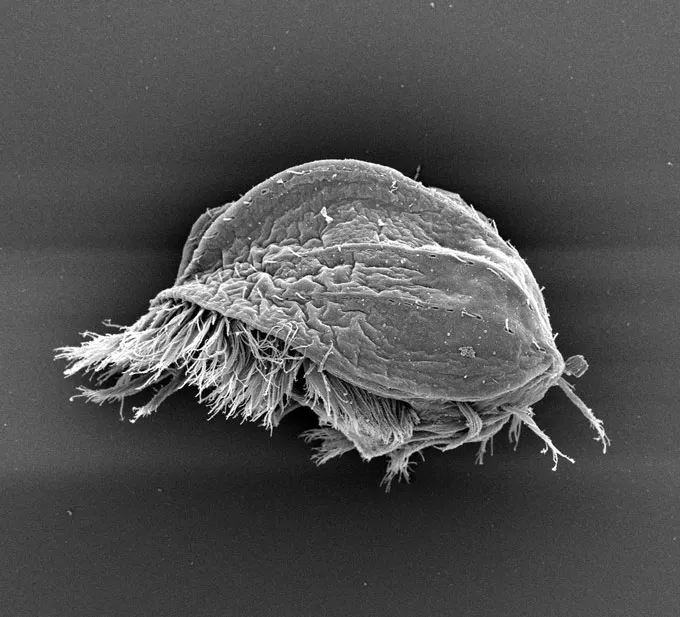
A side view of Euplotes gigatrox. The single celled protist looks as if it has a turtle shell with a fringe of hairlike cilia protruding from underneath.
Euplotes gigatrox has two different forms: regular size and supergiant. This is a side view of the supergiant version, which eats its smaller siblings by running over them and jamming them into its mouth. The mouth is located behind the fringe of hairlike cilia.Ben T. Larson and Samuel J. Lord
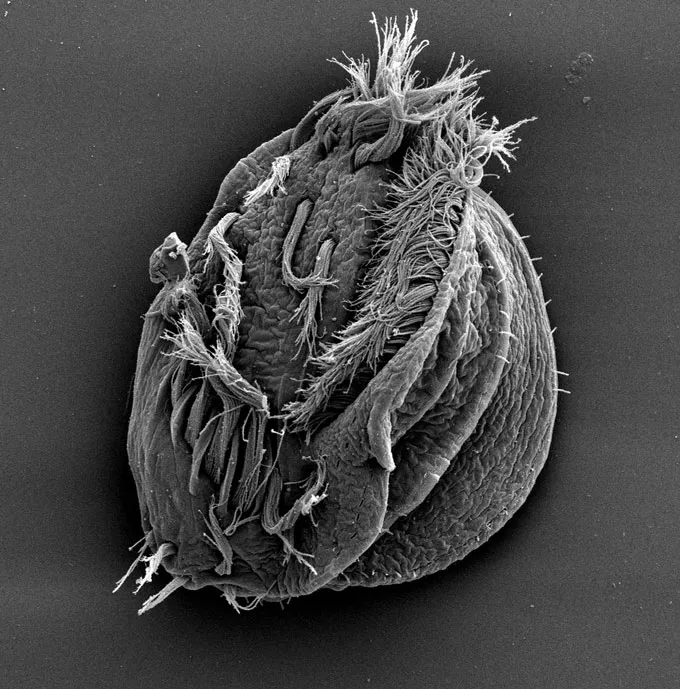
The underside of the protist Euplotes gigatrox showing many hairlike cilia surrounding an oval depression that is the organism's mouth.
Euplotes gigatrox may look like an insect, but it is a type of single-celled protist called a ciliate. It has lots of hairlike cilia surrounding its mouth parts (large oval depression, top). Shown is the underside of the organism’s supergiant form.Ben T. Larson and Samuel J. Lord

And like Bruce Banner and the Hulk, the giants and the regular-size cells behave differently. Besides the cannibalism, the big cells walk in circles and no longer swim like smaller cells can.

Giants can return to their former size by dividing asymmetrically. The Hulks can produce nine normal-size offspring each in a 24-hour period and up to 16 in 120 hours. Normal size E. gigatrox divide just once in 24 hours. With each lopsided division the giant cells shrink until they are back to normal size and behavior.

Up to 42 percent of the organism’s genes are involved in the transitions from regular size to supergiant and back again, Larson and colleagues found. Learning how the protists transform may help researchers understand how simple organisms can develop complex behaviors, and perhaps how multicellular life evolved.

Tina Hesman Saey is the senior staff writer and reports on molecular biology. She has a Ph.D. in molecular genetics from Washington University in St. Louis and a master’s degree in science journalism from Boston University.


Original Source Link

Latest News

Running on a treadmill is easier than running outside. Does that matter?

You hop on the treadmill, set your pace and easily knock out a couple of kilometers (about 1.2...

Viewpoint Discrimination Challenge to Utah Legislature’s Media Credentialing Policy Can Go Forward

From Utah Political Watch, Inc. v. Musselman, decided yesterday by Judges Timothy Tymkovich, Michael Murphy, and Robert Bacharach:...

Guterres Warns U.N. Agency For Palestinian Refugees Nearing ‘Breaking Point’

June 30 (Reuters) - U.N. Secretary-General Antonio Guterres on Tuesday urged countries to cover a $100 million gap...

Nvidia says it can cut data center water use. The AI boom has a bigger problem

Hotter-running liquid cooling could reduce the need for evaporative cooling on-site. But the facilities’ appetite for electricity still...

Must Read

Today in Supreme Court History: June 28, 2010

I WANT FREE MINDS AND FREE MARKETS! Help Reason...
- Advertisement -

You might also likeRELATED
Recommended to you