

By Howard Bloom
The two biggest issues on the table in our negotiations with Iran are a do or die for the world’s economy—the Strait of Hormuz– and a possible do or die for humankind– Iran’s nuclear program.
How are the Iran talks going this week? Lumpy, bumpy and confused.

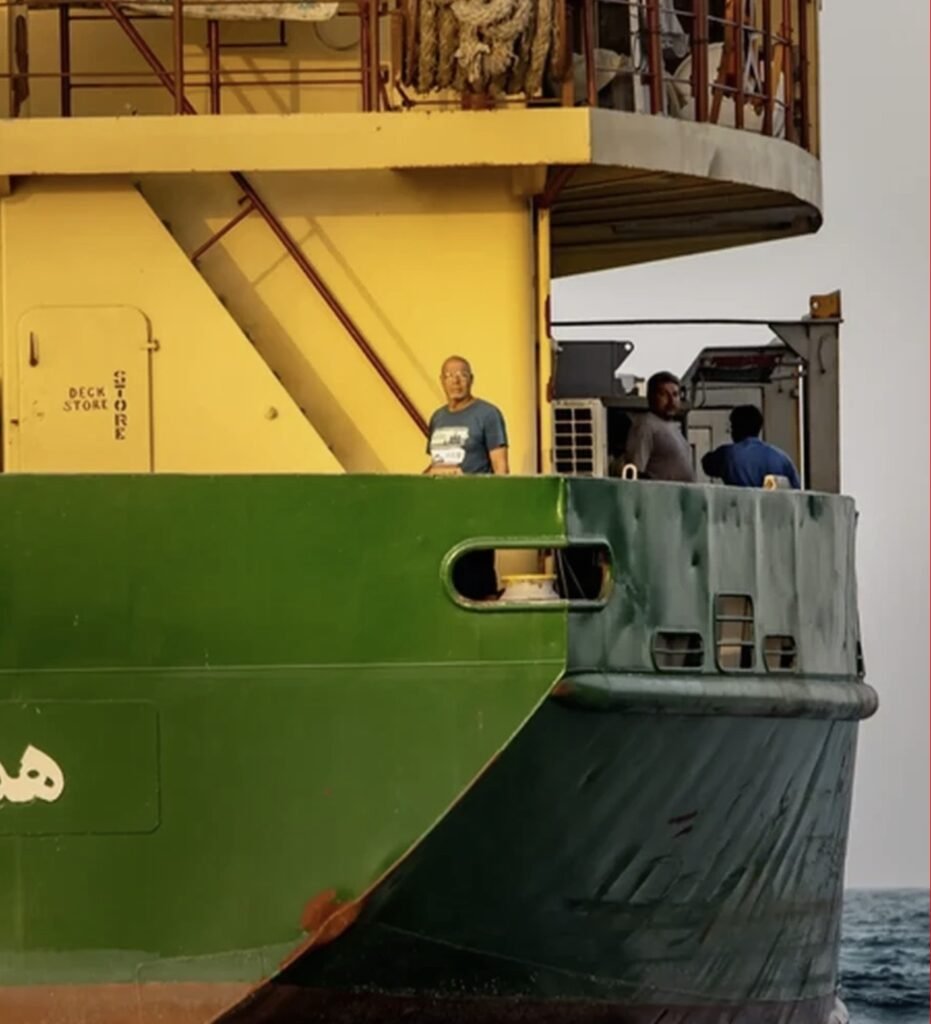
Thursday of last week, June 25th, Iran struck a Singapore-flagged commercial tanker with a kamikaze drone. The command center of the ship, its bridge, was damaged. The ship’s sin was apparently that instead of following Iran‘s shore on the north of the strait, the vessel followed Oman’s coast on the south. And taking that Oman route could be a way of dodging the total control of the Iranians.
After all, just a month ago Iran set up a new governmental body—the Persian Gulf Strait Authority (PGSA)– to rule the entire Strait.
America called this Iranian drone strike a violation of the Memorandum Of Understanding that Iran and the USA had signed on June 17th. So we responded on Friday, June 26th, with strikes against Iran’s storage and launch facilities and against coastal radar installations near the Strait.
Over last weekend, our president, Donald Trump, said that despite this military action, Iran had called asking to continue our meetings in Qatar, the meetings designed to hammer out the details of a peace agreement based on the June 17th memorandum of understanding.
On Tuesday of this week, when Steve Witkoff and Jared Kushner flew to the Middle East for the meetings our president implied that the Iranians had begged for, the two American negotiators were met with an Iranian insult. An Iranian delegation had flown to Doha, where the meetings were to take place. But they would not meet with Kushner and Witkoff. Instead, they met with Qatar’s Prime Minister, Sheikh Mohammed bin Abdulrahman Al Thani, who then apparently shuttled to another room to meet with the Americans. It was a game of telephone. Of true shuttle diplomacy. Nonetheless the Americans said Wednesday, July 1, that they had made “positive progress.” They did not explain what that progress might have been.

The Western press tends not to know Islamic history and holy scripts, so our missed a crucial problem. Any conversation in these meetings about the Strait of Hormuz will be locked in a knot. Why? Because of Allah. Yes, because of god himself.
Wednesday June 2nd, Iran’s parliament speaker and key negotiator Mohammad Bagher Ghalibaf proclaimed that the Strait of Hormuz was “a divine gift that God gave us in this war, which is our greatest instrument of power.” That gives the Strait of Hormuz a standing that towers over the laws of the sea. In Islam, what god gives, you cannot easily give up. Or return to its previous status.
So the Iranians swear that relinquishing control of the Strait of Hormuz is off-the-table, non-negotiable, something the deliberations with the Americans are not even allowed to discuss. And Iran is setting itself up to be the owner and operator of the strait, charging fees for services of roughly a million dollars per ship from the end of the 60-day MOU until the day of judgement.

Then there’s a second major requirement for any peace agreement—Iran’s abandonment of nuclear weapons. Our president has proclaimed that Iran will never get a nuclear bomb. In fact, he’s insisted on it over and over again. For good reason. Iran is developing missiles that can carry atomic warheads to our biggest cities.
But there’s a serious hitch. Says Iran’s Parliament Speaker and key negotiator Ghalibaf, recent Western reports that Iran will give the International Atomic Energy Agency the right to inspect Iran’s nuclear facilities are “false.”
So what are the negotiations in Doha really all about? As Iran sees it, America’s unconditional surrender to Iran. And thawing the hundred billion dollars of Iranian funds frozen in the world’s banks.
______
About the author: Howard Bloom of the Howard Bloom Institute has been called the Einstein, Newton, Darwin, and Freud of the 21st century by Britain’s Channel 4 TV. Bloom’s new book is The Case of the Sexual Cosmos: Everything You Know About Nature is Wrong. Says Harvard’s Ellen Langer of The Case of the Sexual Cosmos, Bloom “argues that we are not savaging the earth as some would have it, but instead are growing the cosmos. A fascinating read.” One of Bloom’s eight previous books–Global Brain—was the subject of a symposium thrown by the Office of the Secretary of Defense including representatives from the State Department, the Energy Department, DARPA, IBM, and MIT. Bloom’s work has been published in The Washington Post, The Wall Street Journal, Wired, Psychology Today, and the Scientific American. Not to mention in scientific journals like Biosystems, New Ideas in Psychology, and PhysicaPlus. Bloom has appeared over 40 times on Saudi and Iranian TV. Says Joseph Chilton Pearce, author of Evolution’s End and The Crack in the Cosmic Egg, “I have finished Howard Bloom’s [first two] books, The Lucifer Principle and Global Brain, in that order, and am seriously awed, near overwhelmed by the magnitude of what he has done. I never expected to see, in any form, from any sector, such an accomplishment. I doubt there is a stronger intellect than Bloom’s on the planet.” For more, seehttp://howardbloom.net or http://howardbloom.institute
______
References:
Middle Eastern Sources
Al Jazeera. “Iran War Live: US Strikes Iran After Fire on Vessel in Strait of Hormuz.” Al Jazeera, June 27, 2026.
Asharq Al-Awsat. “Terms Political Outcomes… War Seemingly Never Happened.” Asharq Al-Awsat, English Edition, July 1, 2026.
Galibaf, Mohammad Bagher. Remarks on the Strait of Hormuz as “a divine gift.” Quoted in PressTV, “Iran Top Security: Leader’s Blood Pursued,” July 1, 2026.
https://www.presstv.ir/Detail/2026/07/01/771411/Iran-top-security-Leader-s-blood-pursued
PressTV. “US Saudi Ties Strained Iran Offensive.” PressTV, July 1, 2026.
https://www.presstv.ir/Detail/2026/07/01/771445/US-Saudi-ties-strained-Iran-offensive
International Organizations
International Atomic Energy Agency. “IAEA and Iran: Recent Inspection Status.” IAEA Board Report, June 2026.
https://www.iaea.org/newscenter/…
United Nations Convention on the Law of the Sea. Part III, “Straits Used for International Navigation.” 1982.
https://www.un.org/depts/los/convention_agreements/texts/unclos/unclos_e.pdf
U.S. Government & Official Statements
Trump, Donald J. Comments on Iran requesting continued Qatar meetings. Transcript of press conference, June 29, 2026. C-SPAN Archives.
https://www.c-span.org/video/?…
U.S. Central Command. “US Strikes Iran in Response to Attack on Commercial Vessel.” U.S. Central Command Public Releases, June 26/27, 2026.
U.S. Department of Defense. “Statement on Retaliatory Strikes Against Iranian Missile and Drone Facilities.” Press Release, June 26, 2026.
https://www.defense.gov/News/Releases/…
Global Media & Industry Publications
CNN. “Live News: Iran War, Trump.” CNN, July 1, 2026.
https://www.cnn.com/2026/07/01/world/live-news/iran-war-trump
Firstpost. “‘Strait of Hormuz is divine gift’: Iran invokes God to claim right to charge fee.” Firstpost, July 1, 2026.
Maritime Executive. “Singapore-Flagged Tanker Struck by Drone in Strait of Hormuz.” June 25, 2026.
https://www.maritime-executive.com/article/…
Reuters. “US, Iran Negotiators Use Shuttle Diplomacy in Doha After Snub / US Launches Strikes on Iranian Military Targets.” June 27 / July 1, 2026.
https://www.reuters.com/world/middle-east/…
The Wall Street Journal. “A Dispute Over Opening Hormuz Drives a Wedge Into U.S.-Saudi Relations.” July 1, 2026.
Time Staff. “Iran Strikes Vessel in Strait of Hormuz as UN Weighs Escort for Shipping; Oil Prices Spike, Trump Responds.” Time, June 26, 2026.
https://time.com/article/2026/06/26/strait-hormuz-iran-strike-vessel-un-escort-shipping-oil-trump


