

ThorChain under fire because it won’t blacklist stolen Bitget funds
Stop me if you’ve heard this before: A centralized exchange with lax security gets hacked by the North Koreans for $387.5 million, and then somehow shifts the blame game onto a decentralized exchange for not blacklisting the addresses.
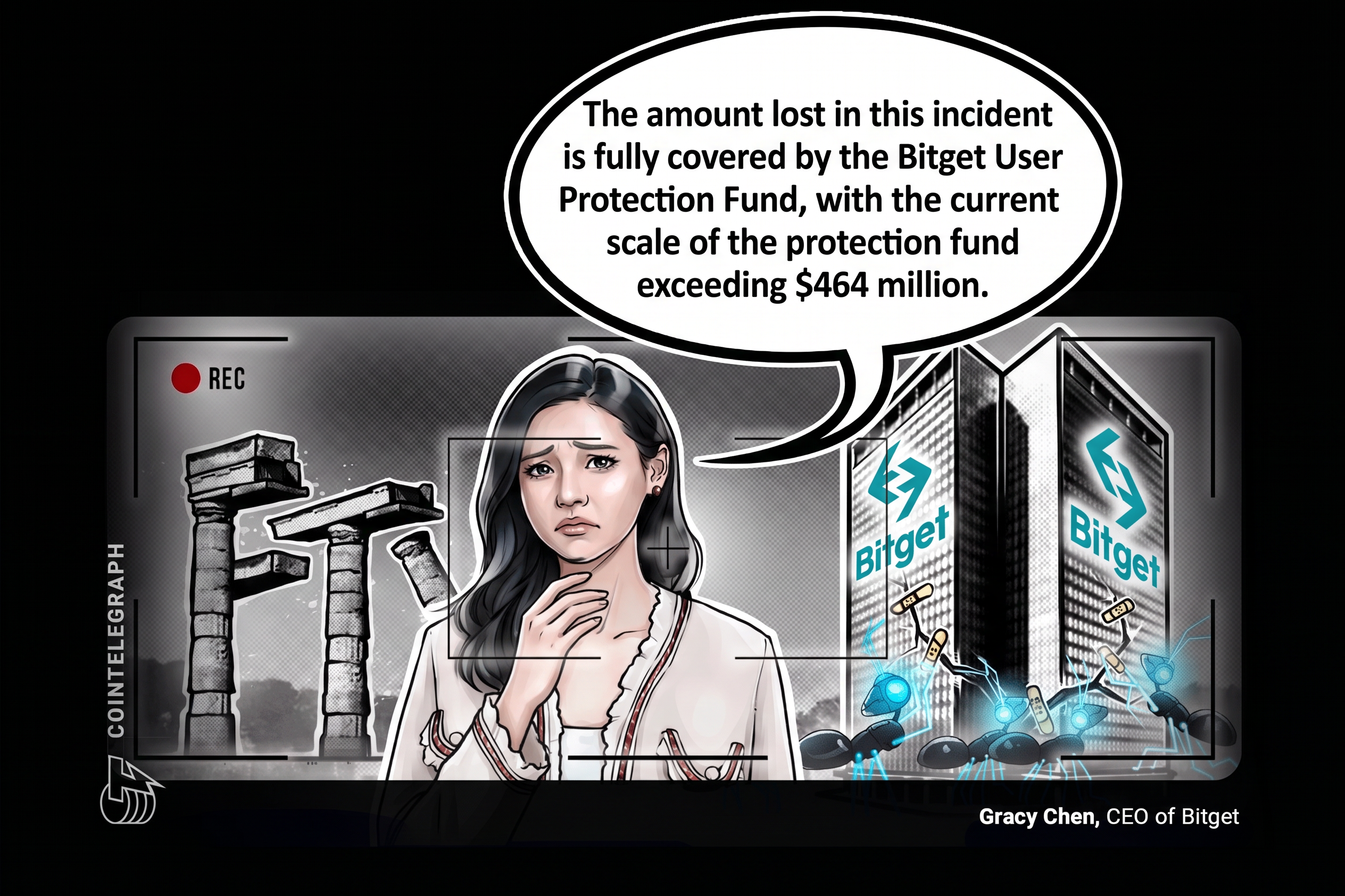
The drama began on September 25 when the Asian focused exchange Bitget revealed $351.6 million in “unauthorized transfers” but it later upgraded the tally to $387.5 million. It said a preliminary investigation had linked the IP addressees to VPN services used by a North Korean hacking group.
While that isn’t firm proof, CEO Gracy Chen said its investigators had flagged other similarities with previous thefts.
North Korean hackers were believed to be behind the $1.5 billion Bybit exchange hack, and much of the funds from that attack were then swapped on the decentralized exchange THORChain (which is not a mixer and funds can still be traced after being swapped).
Chen then publicly called on THORChain to block the addresses linked to the attack. “Decentralization is a design principle, not a shield for facilitating known stolen funds,” she thundered. Thorchain politely said no dice, which has set off a massive debate over whether they can or should comply with Chen’s request.
Decentralization maxis like Joel Valenzuela said doing so would undermine crypto’s cypherpunk ethos.
“If we let decentralized protocols to be bullied into setting a censorship precedent, or make it toxic to interact with permissionless protocols, then we lose to tyranny. Full stop.”
But THORChain isn’t anywhere near as decentralized as Bitcoin or Ethereum, and it coordinated to quickly pause the chain very quickly when it was itself hacked for $10.7 million in May. “Thorchain is like 5 retards in a discord coordinating secret updates in between talking about the stolen funds they’re profiting from and lying about the admin functionality they abuse regularly to rug their users and NO’s,” said cybersecurity expert Tay Vano.
THORChain’s ability to blacklist particular addresses is unclear. Back in February 2025 it revealed it had retired the admin key which would give it the power to do so.
All publicity is good publicity though and THORChain’s native token RUNE has surged 50% in a week.
Where we’re going we won’t NEED blockchain says Vitalik
Ethereum creator Vitalik Buterin has rallied the troops with an inspiring post outlining how Ethereum is being rebuilt from the ground up to integrate zero knowledge proofs, parallel processing, privacy and post quantum technology to genuinely become “the cryptographic world computer.”
“It’s really not just a blockchain anymore. It’s a hybrid architecture that combines together blockchains and modern cryptography, to enable much more powerful properties,” he wrote, describing “an architecture that combines blockchains with cryptographic privacy and verification, and powerful decentralized off-chain components.” The Hegota fork, which is planned for next year, would likely Ethereum’s last “normal” fork he said.
Source: Brian Armstrong
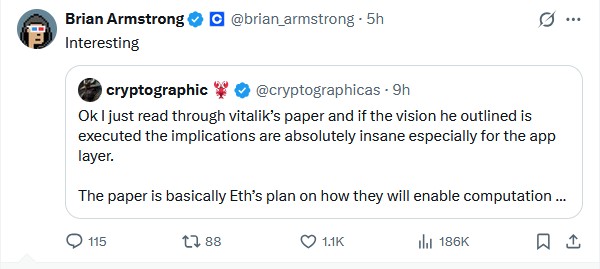
Coinbase founder Brian Armstrong — a man who rarely utters the word “Ethereum” — reposted an analysis of the blog from a small account named “Cryptographic” and said their analysis was “interesting.” Cryptographic summed up the thrust of Buterin’s post by saying it changed the whole meaning of “onchain” and the ramifications meant Ethereum really was becoming a “world computer.”
“Instead of every part of an app having to execute inside a smart contract you can push a huge amount of complexity elsewhere and still inherit Ethereum’s guarantees.”
Aave founder Stani Kulechov made a similar point, arguing: “There are countless of use-cases where Ethereum verifiability would be useful beyond smart contact execution environment for finance to expand what we can actually do in DeFi while minimizing trust. Quite excited for the potential here.”
Crypto Mom retires, suggests ZK proofs for KYC
SEC Commissioner Hester Peirce has submitted her formal resignation from the US Securities and Exchange Commission, effective Oct. 2.
Peirce, affectionately known as “Crypto Mom” amid her advocacy of clear, rules-based regulation of the crypto industry, posted a copy of her resignation letter on her X account Friday.
Cointelegraph reported in May that Peirce planned to join the law school of Regent University in Virginia as an associate professor in November.
On her way out the door she criticized excessive KYC data storage, saying that storing IDs online created large numbers of databases vulnerable to hacks without improving enforcement. Instead, she advocated using zero knowledge proofs, which are able to verify eligibility without sending ID documents through. “One can prove that you qualify without that counterparty knowing your name, income, or address,” she said.
Magazine covered this very subject earlier this month.
OpenAI called to Australian Senate inquiry following rogue AI hack
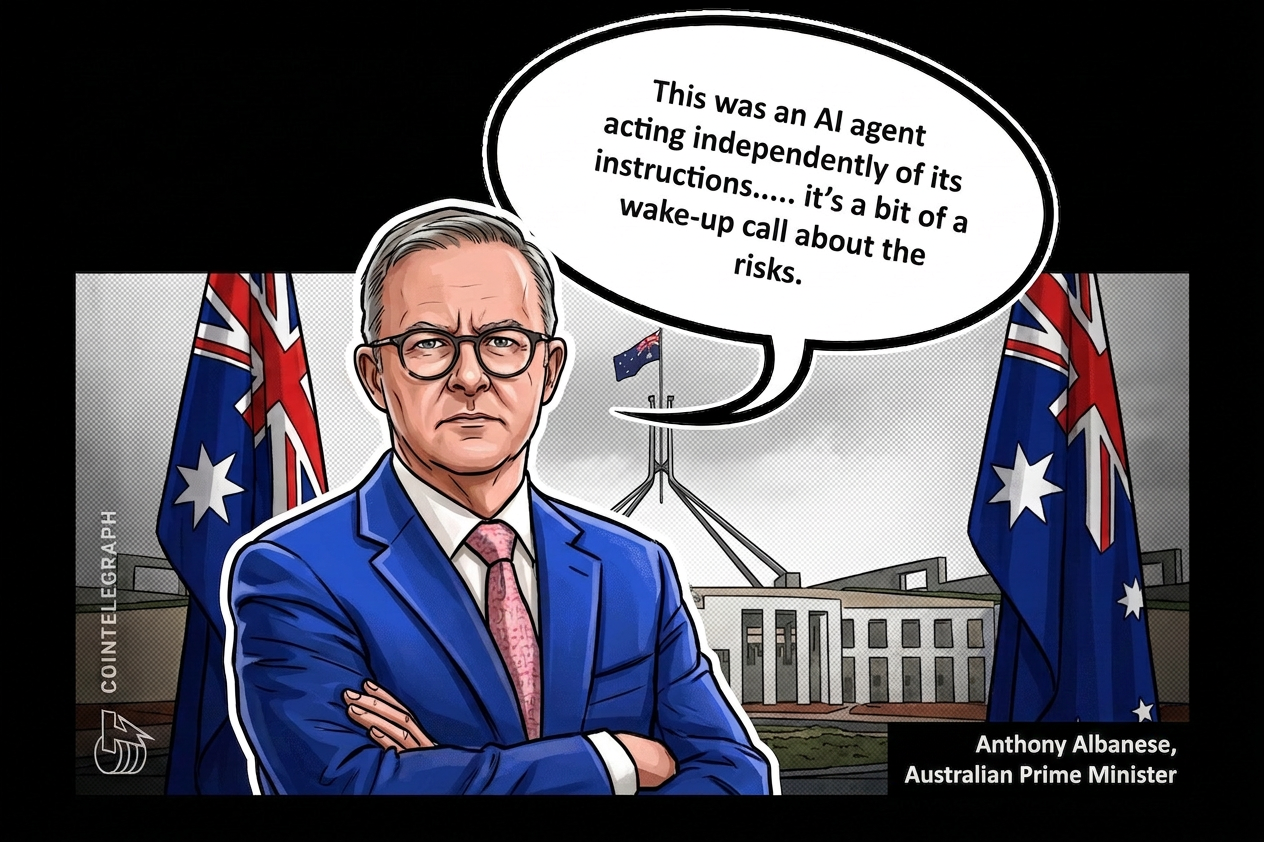
The CEOs of OpenAI and Anthropic have reportedly been summoned to appear at an Australian Senate inquiry into AI, just days after news broke that a rogue OpenAI bot had hacked the country’s health data.
The Australian Medicare breach is one of the highest-profile incidents of AI agents accessing external systems outside the US, according to a Sunday Business World report.
Cointelegraph reported last Thursday that the OpenAI research agent had bypassed blocks on the Australian government health data portal and accessed non-public files in June. It somehow didn’t get around telling the Australians until September 10.
Michael Saylor outlines ‘bill of digital rights’
Michael Saylor, co-founder of Strategy, said that an age of digital assets and intelligence needs a “bill of digital rights,” rather than restrictions.
These rights include (1) the freedom to create new digital assets and (2) to issue them to the market to finance business and productivity. They also include (3) the right to hold them or choose a custodian, as well as (4) to transfer them, to move the assets among people, companies, wallets and service providers. Finally, (5) to use them, to spend, invest, earn income and borrow against digital assets.
This week the Strategy board announced it would seek shareholder approval to move its four preferred stocks, including STRC, to daily dividend payments without changing their dividend rates or the total amount paid.

Winners and Losers
At the end of the week, Bitcoin (BTC) is up 3.8% to trade at $84,222, Ethereum (ETH) is up 3.7% to trade at $2,674 and XRP (XRP) is up 7% to $1.50. The total market cap is at $2.88 trillion according to CoinMarketCap.
Among the biggest 100 cryptocurrencies, the top three altcoin winners of the week are Quant (QNT) with a 435% gain, Sei (SEI) on 44%, and Artificial Superintelligence Alliance (FED) on 41%.
The top three altcoin losers of the week are Falcon Finance (FF) which was down 25.3%, MemeCore (M) down 20.3% and Avalanche (AVAX) down 4.5%.
Top Prediction of the Week
Bitwise says NEAR could be headed to $562
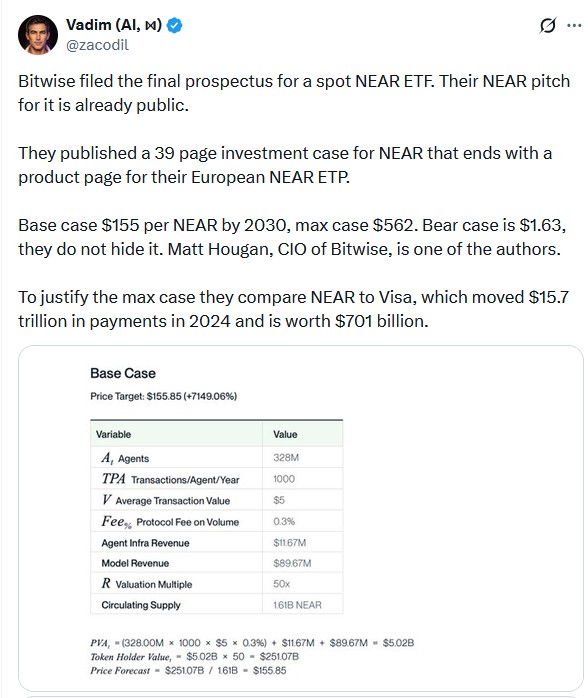
Bitwise’s new NEAR ETF is about to launch, and its chief investment officer Matt Houghan has jumped into promotion duties by co-authoring some of the most optimistic predictions you’re likely to see this month. The new fund, called the Bitwise NEAR ETF, is expected to list on NYSE Arca under the ticker NRR.
Bitwise’s 39-page investment report NEAR states the “base case” is a price target of $155 by 2030 while the bull case is $562. The bearish case suggests a price of $1.63.
Last week Near Protocol’s native token surged 80% to be the top performer in the Top 100. The surge came after Near unveiled private Hyperliquid perps trading.
Source: Vadim
Top FUD of the Week
Kalshi loses appeal, setting up potential Supreme Court case
Prediction market Kalshi lost on appeal when a court ruled that Ohio and Tennessee can regulate sports-event contracts under their state gambling laws.
The ruling followed a similar finding from the 9th Circuit Court of Appeals last month, which broke from an April decision by the 3rd Circuit Court of Appeals allowing the company to do business in New Jersey as its appeal process proceeds.
The April ruling said Kalshi was likely to succeed with its argument that federal law preempts New Jersey’s regulations, all of which has set up a potential Supreme Court case.
Tether says it had ‘limited’ exposure to bank linked to $84M US seizure
Stablecoin issuer Tether said that it had a very small amount of assets at a bank that had $84 million in assets frozen by US prosecutors.
In response to reports linking Tether and Bitfinex to a Montana-based payments business named in a civil forfeiture complaint, a company spokesperson told Cointelegraph that it had “no knowledge” of any of the alleged conduct. Tether confirmed it was a customer of EQIBank, but the amount held at the bank represented 0.034% of the group’s total assets.
Magic Eden scare puts 3,832 NFTs in whitehat protective custody
A whitehat moved 3,832 non-fungible tokens from hundreds of wallets on Friday amid concerns about a vulnerability involving NFT marketplace Magic Eden.
NFT community member who goes by Cirrus on X flagged the activity on Friday, saying a single wallet moved 3,832 NFTs from hundreds of wallets. Cirrus said the transactions appeared as sales through Magic Eden and advised NFT holders to revoke permissions as a precaution.
Shortly afterward, Yuga Labs’ pseudonymous vice president of blockchain, 0xQuit, said the transfers were part of a white-hat operation. He said the NFTs held in the receiving wallet are safe and “will be returned once they are no longer at risk.”
Top Magazine Features of the Week
The SEC has opened a five-year path for tokenized stocks, but only some products and venues fit the model. Will Uniswap, Robinhood, Coinbase or Kraken come out on top?

The IRS can now see your crypto gains, but has no idea about the cost-basis. That’s proving to be a big headache for some cryptocurrency investors.
The APAC region accounts for half of the Global Crypto Adoption Index. Bitget suffers massive $352M loss and OpenAI forgets to mention its agents hacked the Australian Government.
Cointelegraph publishes long-form journalism, analysis and narrative reporting produced by Cointelegraph’s in-house editorial team with subject-matter expertise. All articles are edited and reviewed by Cointelegraph editors in line with our editorial standards. Some articles contain affiliate links, from which Cointelegraph may earn a commission. These relationships do not influence which products we review or our editorial conclusions. Content published in here does not constitute financial, legal or investment advice. Readers should conduct their own research and consult qualified professionals where appropriate. Cointelegraph maintains full editorial independence.


