

In the summer of 2021, Ivie Atuwatse III became Olori — queen consort — of the Warri Kingdom, an Itsekiri monarchy seated in the oil-rich Niger Delta of southern Nigeria. It was, by her own account, a year that arrived braided with grief and enthronement at once, the kind of year that asks a person to become someone new before they have finished mourning who they were. Five years later, she has turned that reckoning into a book.
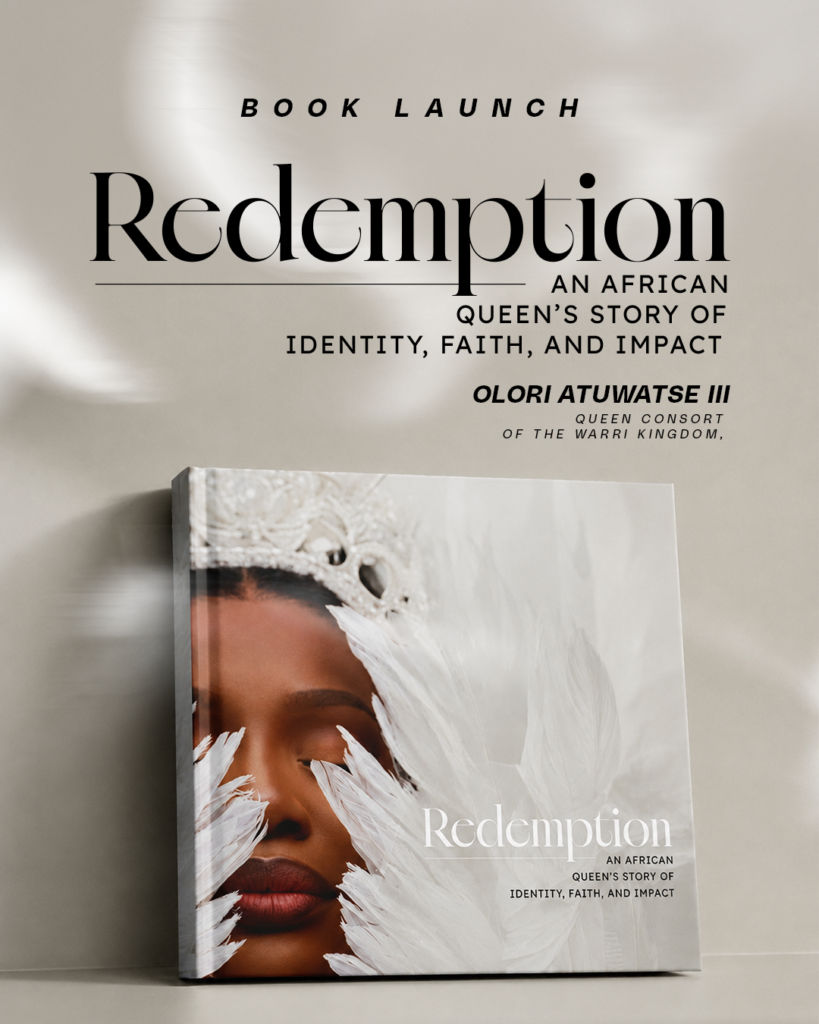
Redemption, released in late June, is billed as a coffee-table volume, and in the hand it behaves like one: heavy stock, striking portraiture, a cover built for a shelf where it will be seen. But the photographs are not the point so much as the argument they carry. Built around annual birthday portrait sessions with photographer Henry Oji, interleaved with images from her work in classrooms, gardens, and clinics across the kingdom, the book traces what its publisher describes as a five-year passage from private unraveling to public purpose — private transformation and public responsibility becoming, in the queen’s telling, inseparable.

“I spent over thirty years believing a lie about who I was,” she writes in the book’s opening pages, adding that the years since her enthronement rewrote that story considerably faster. It is a striking admission from a woman who, on paper, arrived at the Warri throne well armored against self-doubt: a law degree from the London School of Economics, a call to the Nigerian Bar in 2010, and a marriage in 2014 to Tsola Emiko years before he would ascend as the 21st Olu of Warri. The credentials, Redemption suggests, were never the issue. The interior story was slower to catch up with the exterior one.
That interior story has increasingly become the subject of her public work rather than something kept behind the palace gates. Earlier this summer, when she released the 40th-birthday portraits that anchor the book’s final chapter, she resisted having them read as vanity or celebration. They function instead, she has said, as a testimony made visible for anyone who needs reminding that a promise, once made, gets kept — a reframing that turns a glamour sitting into something closer to sworn evidence than souvenir.
The Warri Kingdom itself supplies the book’s harder edges. Situated in the heart of Nigeria’s oil-producing Niger Delta, the kingdom sits atop petroleum wealth that has helped fuel one of Africa’s largest economies for decades, even as many of the communities around it go without reliable power, clean water, or schools. “The kingdom sadly suffers from what I call the resource curse,” the queen consort told CNN’s Larry Madowo this summer. “Everything is taken out, but nothing is developed.” It is a blunt diagnosis for a member of a royal house to offer on camera, and it frames the charitable machinery she and her husband, Ogiame Atuwatse III, built after his 2021 coronation: the Royal Iwere Foundation, organized around education, empowerment, and environmental work, and the newer Elevate Africa platform, through which she has addressed audiences at the United Nations and convened gatherings as far afield as Botswana.
The foundation’s programs read like a queen consort’s answer to the resource curse rather than a rejection of it — a Teachers’ Training Programme, a STEM and innovation lab named for her late father, Captain Idahosa Wells Okunbo, the Love Garden Project teaching children farming and food sustainability, and EstablishHer, a leadership program for women entrepreneurs. “Everything really is centered around human capital development,” she told CNN, describing an approach that treats the kingdom’s people, rather than its oil, as its principal resource.
That combination of testimony and infrastructure has drawn international attention this year, including a CNN African Voices segment produced in recognition of her work in education, healthcare, and women’s empowerment, and a foreword to Redemption written by her husband, the Olu of Warri himself. It is a rare pairing — a traditional monarchy narrating its own modernization in real time, on a shelf and on satellite television simultaneously.
What makes Redemption more than a vanity project, in the end, is its refusal to separate the two halves of its title from each other. The book does not ask readers to admire a queen’s glow-up so much as to witness a specific claim: that a life quietly rebuilt in private eventually has to show up in the classrooms, gardens, and policy rooms a person has access to, or it was never really rebuilt at all. Whether that claim persuades will depend on the reader. That a sitting queen consort was willing to stake it in print, at all, is itself the story.
“Redemption: An African Queen’s Story of Identity, Faith, and Impact” now Available on Amazon:


